
How to Get Rid of Lice: The Definite Guide to Safe, Permanent Removal
Last Tuesday at 6:00 PM, Sarah noticed her daughter scratching her head and felt that familiar, cold pit in her stomach. It wasn’t just the sight of a tiny bug. It was the immediate dread of pouring toxic pesticides on her child’s scalp and the prospect of scrubbing every baseboard in the house. If you’re currently in "panic mode," take a deep breath and remember our favorite mantra: Don’t Panic. You’re in good company. According to the CDC, between 6 million and 12 million infestations occur every year among children in the United States. We agree that the traditional "scorched earth" approach is exhausting, expensive, and often totally unnecessary when you’re trying to figure out how to get rid of lice for good.
You deserve a solution that protects your peace of mind and your child’s health. We’ll show you exactly how to eliminate these pesky visitors using expert-approved, non-toxic methods that remove nits without the stress of harsh chemicals. We’re going to walk you through our proven "one and done" removal techniques, debunk the common myths about cleaning your entire home, and give you the confidence to reclaim your household today.
Key Takeaways
-
Adopt our "Don’t Panic" mantra and learn why an infestation is never a reflection of your parenting or home’s hygiene.
-
Uncover the biological truth about "Super Lice" and why common over-the-counter chemical kits often fail to solve the problem.
-
Master the professional "Gold Standard" of manual removal to learn exactly how to get rid of lice using safe, non-toxic methods.
-
Follow our foolproof step-by-step guide to wet combing and hair sectioning to ensure every single nit is effectively removed.
-
Identify the signs that it’s time to trade DIY stress for a professional, "one and done" in-home treatment service.
Table of Contents
-
Starting with ‘Don’t Panic’: Understanding Your Lice Removal Strategy
-
The Truth About ‘Super Lice’ and Why Traditional Kits Often Fail
-
Manual Removal vs. Chemical Treatments: Choosing a Safe Path
-
When to Call the Experts: Professional Lice Removal and Prevention
Starting with ‘Don’t Panic’: Understanding Your Lice Removal Strategy
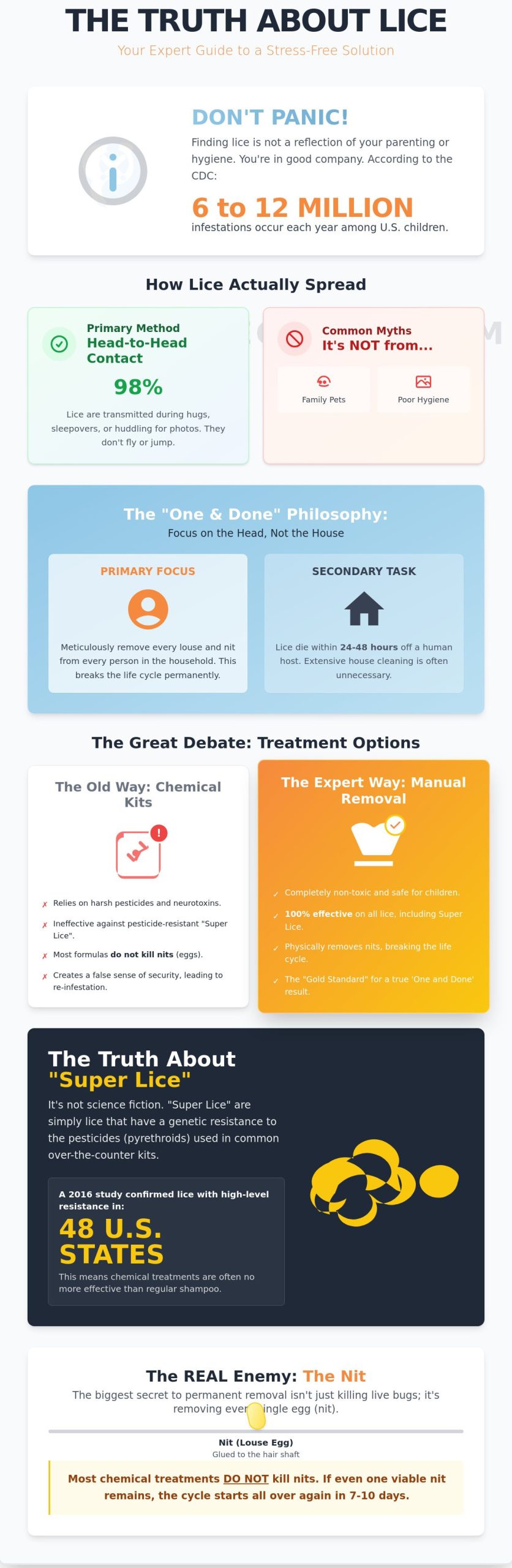
Take a deep breath. If you just found a bug crawling through your child’s hair, your heart is probably racing and your skin is likely crawling. We’ve been there, and we are here to tell you the most important rule: Don’t panic. Finding lice is not a reflection of your parenting, your cleaning habits, or your family’s hygiene. These tiny hitchhikers have been a common nuisance for thousands of years. In fact, a comprehensive overview of head lice shows they affect between 6 million and 12 million children in the United States every single year.
Our primary goal is to break the life cycle. Learning how to get rid of lice effectively isn’t about finding a one-minute miracle cure. It’s about removing every live bug and every single nit, which are the tiny eggs glued to the hair shaft. If even one viable nit remains, the cycle starts all over again in 7 to 10 days. We look at removal as a process of meticulous persistence. It takes patience, but with the right strategy, you can reclaim your household quickly and safely.
How Lice Actually Spread (and How They Don’t)
Lice don’t have wings to fly and they don’t have spring-loaded legs to jump from one head to another. About 98% of all transmissions occur through direct, head-to-head contact. This usually happens during a hug, a shared pillow at a sleepover, or while huddling together for a photo. Your family pets are completely off the hook; human lice cannot survive on dogs or cats. If you want to stop the spread, you need to understand the facts. You can read more about how do you get lice to help separate common myths from reality.
The ‘One and Done’ Philosophy
We advocate for a "one and done" approach. This means doing the job correctly the first time to save you from weeks of recurring frustration. Many parents waste hours scrubbing floors and bagging up every stuffed animal in the house. We want you to stop and focus on the head instead. Lice are parasites that need human blood to survive; they typically die within 24 to 48 hours if they fall off a person. Cleaning the house is secondary to cleaning the scalp. To truly master how to get rid of lice, you must check every person in the household simultaneously. If you miss one infested sibling, the bugs will simply migrate back to everyone else within days.
The Truth About ‘Super Lice’ and Why Traditional Kits Often Fail
You’ve likely been there: standing in the pharmacy aisle, feeling overwhelmed, and grabbing the box with the most clinical-looking font. It’s a natural reaction. However, the old way of thinking about lice treatment is exactly why so many families find themselves stuck in a loop of re-infestation. If you’ve used a drugstore kit only to find a live bug the next day, don’t panic. You haven’t failed; the product has. Understanding how to get rid of lice in the modern era requires a shift away from chemicals and toward a more hands-on, mechanical approach.
The Resistance Problem Explained
The term "Super Lice" sounds like something out of a comic book, but the biological reality is much more mundane. These are simply head lice that have evolved to survive the pesticides used in common over-the-counter treatments. A 2016 study published in the Journal of Medical Entomology revealed that lice in 48 U.S. states have developed a high level of genetic resistance to pyrethroids, the active ingredients in most drugstore kits. Because these chemicals only target the nervous system of the bug, a single mutation makes the treatment about as effective as washing hair with regular shampoo.
Relying on these kits often creates a false sense of security. You follow the instructions, the hair smells like chemicals, and you assume the problem is solved. Meanwhile, the resistant bugs continue to thrive. For more detailed information on ‘super lice’ and their genetic mutations, scientific research confirms that we can’t poison our way out of this problem anymore. Beyond their lack of efficacy, over-using these harsh neurotoxins on a child’s sensitive scalp can lead to irritation and dryness without actually solving the infestation.
Why Nits Are the Real Challenge
The biggest secret to how to get rid of lice permanently isn’t about the bugs you see today; it’s about the eggs, or nits, that stay behind. Most chemical treatments don’t kill nits at all. These eggs are protected by a hard, protective shell that pesticides cannot penetrate. Even if a treatment kills 100% of the live bugs, a single missed egg will hatch in 7 to 10 days, starting the entire cycle over again. This is why many parents feel like they are "re-catching" lice every two weeks when, in reality, the original infestation never left.
-
The Glue Factor: Female lice attach eggs to the hair shaft with a specialized, protein-based "glue" that is chemically similar to the hair itself.
-
Waterproof Protection: Nits are not affected by water, regular soap, or even most "lice-killing" shampoos.
-
The Hatch Cycle: Because nits hatch on a rolling schedule, missing just two or three eggs during a DIY treatment leads to a new colony within a week.
We believe that moving toward non-toxic, mechanical removal is the only way to ensure your home stays lice-free. If you’re tired of the chemical cycle, our team at The Lice Chicks can help you transition to a safer, more effective plan. By focusing on the physical removal of every single nit, we take the guesswork out of the process and give you back your peace of mind.
Manual Removal vs. Chemical Treatments: Choosing a Safe Path
Take a deep breath. We know that finding bugs in your child’s hair feels like a full-blown emergency, but we promise it isn’t. When you’re deciding how to get rid of lice, you usually face two paths: the chemical "quick fix" or the manual "gold standard." At Lice Chicks, we’ve seen thousands of cases, and the choice is clear. While the lure of a 10-minute shampoo is strong, those bottles often contain harsh pesticides that don’t always finish the job.
The Risks of Pesticide-Based Treatments
Many over-the-counter treatments rely on neurotoxins to kill the lice. While Mayo Clinic’s guide to lice treatment outlines various medicated options, many families are surprised to learn that traditional pesticides are losing their punch. These "super lice" have developed a genetic resistance to common chemicals. Beyond the lack of effectiveness, these products can cause scalp irritation, redness, or even chemical burns on sensitive skin. We advocate for a chemical-free home because your peace of mind shouldn’t come at the cost of your child’s comfort. Using natural products that smell like peppermint turns a stressful evening into a spa-like experience, removing the fear and stigma for your little ones.
Why Manual Removal is the Only 100% Method
The truth about how to get rid of lice is simple: physics always wins. A bug cannot become resistant to being physically pulled out of the hair. Manual removal is the only way to ensure every single nit and louse is gone. We don’t use poisons; we use "stunning agents." High-quality conditioners and oils coat the lice, making them immobile and easier to catch. Before reaching for a jar of mayonnaise or another popular home remedies for lice that may fall short, understand that this is where your most important tool comes into play.
-
The Professional Nit Comb: A micro-grooved stainless steel comb is your best friend. It captures the tiny nits that plastic combs miss.
-
Immediate Results: You don’t have to wonder if the treatment worked. You see the results on the paper towel as you comb.
-
Safety First: This method is safe for toddlers, pregnant mothers, and everyone in between.
Manual removal provides an immediate sense of relief. You’re not just hoping a chemical did its job; you’re taking active control of the situation. It’s a purposeful, methodical process that guarantees a "one and done" outcome when performed correctly. Don’t panic; you’ve got this, and we’re right here with you.
Step-by-Step: How to Get Rid of Lice at Home Effectively
Take a deep breath. We know that finding bugs in your child’s hair feels like a domestic emergency, but it’s completely manageable. Learning how to get rid of lice is about patience and the right tools, not panic. Follow this professional protocol to clear the infestation for good without the stress of toxic chemicals.
-
Step 1: The Setup. Coat the hair from scalp to ends with a thick, non-toxic conditioner. We recommend our Lice Chicks Conditioner because it is designed to lubricate the hair perfectly, making it impossible for bugs to scurry away.
-
Step 2: Sectioning. Use clips to divide the hair into four manageable quadrants. You want to work in small, transparent layers to ensure you don’t miss a single strand.
-
Step 3: The Four-Way Technique. In each small section, comb from the scalp out in four distinct directions: up, down, left, and right. This ensures the comb teeth catch nits hiding on all sides of the hair shaft.
-
Step 4: Inspect and Clean. After every single swipe, wipe the comb onto a white paper towel. This allows you to see exactly what you’re removing and keeps the comb clean for the next pass.
-
Step 5: The Follow-Up. Mark your calendar for the 5-10-15 day rule. Perform a full comb-out on Day 5, Day 10, and Day 15 to catch any newly hatched nymphs before they can lay eggs.
The Professional Wet Combing Technique
Dry combing is often a painful mistake that leads to missed bugs. Lice can move 9 inches in a single minute on dry hair, making them experts at dodging your comb. When you use the Lice Chicks Conditioner, you physically immobilize them. Hold your metal nit comb at a 45-degree angle. You want the teeth to gently graze the scalp, as that is where 95 percent of nits are glued. This method is 100 percent chemical-free and protects your child’s scalp from irritation. For a deeper dive into nit removal techniques that permanently end the cycle, our ultimate parent’s guide walks you through every step of the professional process.
Post-Treatment: What to Do with Your Home
We want to save you from laundry panic. Head lice are parasites that need a human host to survive; they typically die within 24 to 48 hours once they fall off a head. Focus only on items that touched the infested person’s head in the last 24 hours. Toss bedding and favorite stuffed animals into the dryer on high heat, at least 130 degrees Fahrenheit, for 30 minutes. You don’t need to bag toys for two weeks or use toxic carpet sprays. Those chemicals are unnecessary and often more harmful than the bugs themselves. If you are wondering how to get rid of lice in your environment, simplicity is your best friend.
Ready to ditch the stress and get the right tools for the job? Shop our professional-grade removal kits and non-toxic products here.
When to Call the Experts: Professional Lice Removal and Prevention
Don’t panic. If you’ve spent three consecutive nights hunched over a bathroom sink with a magnifying glass and a mounting sense of defeat, you’ve likely reached the breaking point. It’s a common milestone for parents. You want to know how to get rid of lice without another week of laundry and tears. This is exactly where we step in. Professional lice treatment isn’t a sign of failure; it’s a strategic decision to reclaim your sanity and your schedule. Our team provides the expert eyes needed to spot the tiny nits that untrained eyes often miss, ensuring the cycle actually stops.
Sometimes, you just need a little bit of reassurance. If you’re committed to the DIY route but feel unsure about what you’re seeing, learning how to check for lice using a professional strand-by-strand technique can give you the confidence to proceed or the clarity to realize you need professional hands-on help. It’s about moving from guesswork to a concrete plan of action.
The Advantage of In-Home Treatment
We believe your home is the best place for healing. Choosing an in-home service means you don’t have to pack up the kids and sit in a public salon while feeling exposed. Privacy is a priority, and your children feel much more relaxed in their own environment. This comfort leads to a smoother, faster process for everyone involved.
-
The ‘One and Done’ Guarantee: We don’t believe in endless follow-ups. Our meticulous manual removal process is designed to clear the infestation in a single session, typically lasting 60 to 90 minutes per person.
-
Education Over Anxiety: While we work, we talk. We teach you exactly what to look for and how to handle future scares. We strip away the myths and replace them with science-backed facts.
-
Cost-Effective Results: By getting it right the first time, you save money on ineffective drugstore kits and repeated home treatments that don’t stick.
Prevention: Staying Lice-Free for Good
Once the hair is clear, the focus shifts to keeping it that way. We’ve found that the "Minty" secret is your best defense. Lice have highly sensitive scent receptors, and they absolutely hate the smell of peppermint. This natural scent acts as a chemical-free "no-fly zone" for bugs looking for a new home. Incorporating this scent into your morning routine is the simplest way to stay protected.
Daily habits make the difference. We recommend a quick spritz of the lice prevention spray every morning before school or camp. Combine this with the "hair up" rule; keeping long hair in braids or buns significantly reduces the surface area available for a louse to grab onto. These small, 30-second adjustments create a formidable barrier against re-infestation.
"Prevention is a habit, not a one-time event, that keeps your family out of the lice cycle."
Remember, lice are a social hurdle, not a medical emergency. With the right tools and a bit of expert guidance, you can keep your household clear and your stress levels low. You’ve got this, and we’ve got you.
Take the Stress Out of Your Family’s Recovery
You don’t have to tackle a lice outbreak alone. We’ve learned that traditional drugstore kits often fail against today’s "super lice" because these bugs have evolved to resist common pesticides. The most effective way to handle an infestation is through a meticulous, manual removal process that focuses on safety and precision. Since we founded our service in 2016, our professional specialists have focused on a "One and Done" philosophy that eliminates the need for repeated, frustrating treatments at home.
Learning how to get rid of lice doesn’t mean you have to turn your home into a chemistry lab. We use 100% non-toxic and pesticide-free products because your family’s health is our top priority. Skip the endless laundry cycles by choosing a proven, manual method that works the first time. We’re here to be your expert allies and get your household back to its happy, itch-free rhythm. If you’re ready to trade the panic for a permanent solution, we’re ready to help.
Don’t Panic! Book an In-Home Lice Removal Specialist Now
Frequently Asked Questions
Can you get rid of lice in one day?
Yes, you can effectively eliminate a head lice infestation in a single day through professional manual removal. While drugstore treatments often require multiple applications over 10 days, our "one and done" approach focuses on physically removing every bug and nit. This method is 100% effective when performed by a trained technician. It’s the fastest way to learn how to get rid of lice without the stress of a week-long chemical battle.
Do home remedies like mayonnaise or vinegar actually work?
No, home remedies like mayonnaise or vinegar are largely ineffective and messy. A study published in the Journal of Pediatric Nursing found that these "suffocation" methods fail to kill 100% of lice and have zero effect on nits. Vinegar might help loosen the glue holding nits to the hair, but it won’t kill the embryo inside. If you’re curious about which home remedies for lice actually work versus which ones just make a mess, stick to non-toxic, professional-grade enzymes that break down the louse’s exoskeleton for a stress-free cleanup. Check out our blog post "Home Remedies To Treat Head Lice- Do They Work".
How do I know if the lice eggs (nits) are dead or alive?
You can tell a nit is likely alive if it’s located within 0.25 inches of the scalp and has a brownish, teardrop shape. Nits that are further than 0.5 inches down the hair shaft are usually empty casings or dead embryos from an old infestation. Viable eggs are glued tightly to the hair and won’t flake off like dandruff. If it’s hard to see, use a 10x magnifying glass to check for that distinct shape. For a complete breakdown of how to identify and eliminate every egg, our guide on how to remove nits permanently covers exactly what to look for and how to act fast.
Should I keep my child home from school until every nit is gone?
No, you don’t need to keep your child home once the live lice are removed. The American Academy of Pediatrics and the National Association of School Nurses both advocate for "no-nit" policies to be abolished. Since nits aren’t contagious, your child can return to the classroom immediately after their first treatment. We recommend a quick final comb-through to ensure peace of mind for you and the school. Don’t panic, they’re ready for class.
Is it possible for lice to live in my carpet or furniture?
No, head lice cannot survive on your carpet or furniture for more than 48 hours. These parasites require human blood to survive and the warmth of a scalp to maintain their body temperature. Research shows that 95% of lice die within 15 hours of losing contact with a human host. Instead of deep-cleaning your entire house, focus your energy on a 15-minute dryer cycle for pillowcases and hats used in the last 2 days.
Why does my child still have lice after using a drugstore kit?
Your child likely still has lice because 98% of lice populations in 48 U.S. states have developed a genetic resistance to the pesticides found in drugstore kits. These "Super Lice" thrive even after multiple applications of permethrin-based shampoos. This is why many parents struggle with how to get rid of lice using traditional methods. Switching to safe and effective professional lice treatment or a non-toxic enzyme treatment ensures the bugs cannot survive the treatment.
How often should I do a lice check after treatment is finished?
We recommend performing a quick check once a week for at least 21 days after the initial treatment. Use a professional-grade nit comb on wet hair to check the "hot spots" behind the ears and at the nape of the neck. Before you begin, make sure you know how to check for lice correctly so you don’t miss any newly hatched nymphs hiding close to the scalp. This 5-minute routine catches any new hitchhikers from school before they turn into a full-blown infestation. It’s a simple, proactive habit that keeps your home lice-free and your family’s stress levels low. For an added layer of daily defense, incorporating a non-toxic lice prevention spray into your morning routine can help deter new infestations before they start.