
Found a Lice Egg on Your Finger? Here is Exactly What to Do Next

Last Tuesday, a mom in Brooklyn was getting her daughter ready for school when she spotted a tiny, teardrop-shaped speck. She pinched it between her nails, and suddenly there was a suspected lice egg on her finger. If you’ve just made the same discovery, our first piece of advice is simple: Don’t Panic. You aren’t alone; in fact, the CDC reports that up to 12 million infestations occur among U.S. children every year.
We know that “grossed out” feeling makes you want to scrub every inch of your house and reach for the strongest chemicals you can find. It’s exhausting to worry about the itch spreading to the whole family. But here’s the truth: your home is still clean, and you don’t need toxic pesticides to handle this. It is a common hurdle that many parents face, and it doesn’t mean you’ve done anything wrong.
In this guide, we’ll teach you our simple “flick test” to tell a nit from dandruff and provide a step-by-step plan to become 100% lice-free. You’ll learn exactly how to identify what you found and how to handle it with our calm, non-toxic approach. We’re here to walk you through the process so you can get back to your stress-free life today.
Key Takeaways
- Learn how to tell the difference between a sticky nit and simple dandruff using our expert “Pinch and Slide” identification test.
- Discover why finding a single lice egg on finger is often just the tip of the iceberg and how to check for a hidden infestation.
- Understand why common drugstore treatments and messy home remedies often fail to work against modern “Super Lice.”
- Explore the “Shepherd Method,” a meticulous strand-by-strand manual removal process that ensures your home stays stress-free.
- Find out how professional, non-toxic in-home care can turn a panicked discovery into a calm and organized plan of action.
Identifying a Lice Egg on Your Finger: What Does it Look Like?
You just found a tiny speck on your hand after scratching your child’s head. If you have a lice egg on finger, your first instinct might be to panic. Take a deep breath. We see this every day, and it is a very manageable situation. Finding a nit is simply the first step toward getting your household back to normal. It’s a common discovery during a routine weekly check or after a notification from a school in Brooklyn or Manhattan.
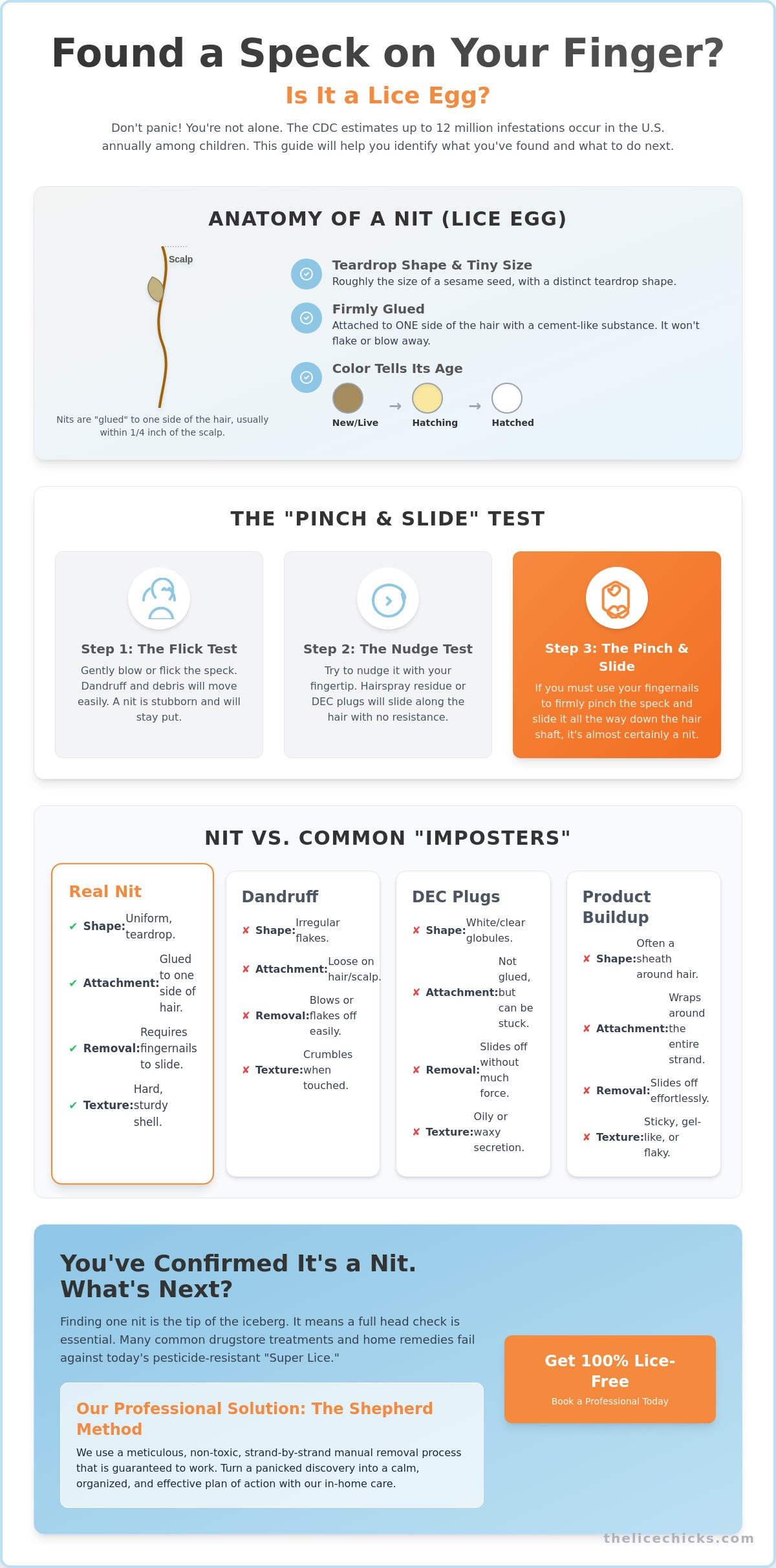
A nit is a tiny egg casing with a distinct teardrop shape. Unlike dandruff or hair product, it won’t just flake off or blow away. It’s firmly attached to one side of the hair shaft. To understand the biology behind these pests, you can learn more about What are head lice? and how they reproduce. These eggs are roughly the size of a sesame seed. Some parents describe them as looking like a small, smooth knot in a piece of thread.
The color of the egg often tells a story about its age. Newly laid eggs are usually tan, brownish, or coffee-colored. As they get closer to hatching, they might appear yellowish-white. If you want to learn more about the life cycle of these bugs, check out our lice facts page. Knowing what you are looking at helps remove the mystery and the fear.
The Appearance of a Live Nit vs. a Hatched Shell
Live nits are usually found within 1/4 inch of the scalp. This proximity provides the steady warmth they need to survive and hatch. They are darker in color and feel plump if you roll them between your fingernails. Hatched shells look different. They appear clear or bright white and are often found further down the hair strand. This happens because the hair has grown since the egg was originally laid. A specialized, cement-like substance acts as a permanent glue that makes nits completely immobile on the hair.
Where You Likely Found It
Lice are smart and look for “hot spots” on the head. They almost always prefer the area behind the ears or at the nape of the neck. These spots provide the perfect incubation temperature for their eggs. If you found a lice egg on finger after checking these specific zones, it’s because the mother louse chose the warmest, most protected environment for her offspring. Using bright natural light or a professional headlamp will change how the egg looks. In the sun, a nit often has a slight sheen or pearlescent glow, while dim indoor lighting makes them look like dull brown specks.
Lice Egg vs. Dandruff: The “Pinch and Slide” Test
Finding a tiny speck and wondering if it’s a lice egg on your finger can make any parent’s heart race. Before you start bagging up the stuffed animals, take a deep breath. We see “false alarms” every single day. The easiest way to know for sure is by using our favorite gold-standard method: the “Pinch and Slide” test.
First, try to simply blow or flick the speck off your finger. If the object is still on a hair strand, give it a gentle tap. If the speck flies away or moves easily, you can probably relax. Real nits are stubborn. They don’t just fall off because of a little breeze or a light touch.
If the speck stays put, try to nudge it with your fingertip. If it slides along the hair with no resistance, it’s likely a “lice imposter” like dandruff or hairspray residue. To be certain, you can follow our step-by-step guide on how to check for lice to ensure you aren’t missing any other signs. If you have to use your fingernails to firmly pinch the speck and slide it all the way down the hair, you’re likely looking at a real nit.
Common “Lice Imposters” to Watch For
It’s easy to mistake everyday scalp debris for an infestation. Dandruff is the most common culprit. These flakes are usually irregular in shape and will crumble into tiny pieces if you touch them. Nits, on the other hand, are teardrop-shaped and very sturdy.
You might also see DEC plugs. These are oily secretions from the scalp that look white or clear. While they look like nits, they aren’t “glued” to the hair. Hair product buildup can also be tricky. Hairspray or gel often wraps entirely around the hair strand, but unlike a nit, it slides off without any effort at all.
Why Nits are So Hard to Remove
If that lice egg on your finger felt like it was cemented to the hair, there’s a biological reason for it. Female lice produce a specialized glue-like substance when they lay their eggs. This chemical compound is incredibly strong, much like the advanced adhesives from LivBay Lash Supplies used in professional beauty applications. It’s designed to keep the egg attached to the warm hair shaft until it hatches about 7 to 9 days later.
This “glue” is the reason standard brushing or washing with regular shampoo won’t work. You can’t simply wash nits away. They require manual removal with a high-quality comb or professional hands. To help keep these pests away in the future, we recommend using specialized Lice Prevention Products that make the hair less attractive to “hitchhikers.”
If you’ve done the test and you’re still not 100% sure what you’re looking at, don’t stay stuck in “lice limbo.” We’ve helped thousands of families find peace of mind. We’re here to help make this as stress-free as possible so you can get back to your day.
Why Finding One Nit Means You Need a Closer Look
Finding a lice egg on finger can feel like your world is tilting. Your first instinct might be to scrub your hands and head for the hills, but take a deep breath. We call this the “iceberg effect.” That tiny, teardrop-shaped speck is usually just the tip of the problem. If you found one, there are almost certainly dozens more hiding near the scalp, especially behind the ears and at the nape of the neck.
Lice don’t care if you’re the cleanest person in Brooklyn or Scarsdale. They actually prefer clean hair because it’s easier to attach their eggs to the hair shaft. They don’t fly, they don’t jump, and they definitely don’t live on your pets. They spread through simple head-to-head contact, which is why they’re so common in local schools and summer camps. It’s a normal part of childhood and not a reflection of your home’s cleanliness.
The Speed of the Lice Life Cycle
A single female louse is a busy little bug. She can lay up to 10 eggs every single day. If you wait just a few days to take action, that one bug can turn into a full infestation of hundreds. The timeline from egg to nymph to egg-laying adult is about 21 days. Waiting to see if more show up is the most common mistake we see parents make. It’s much easier to handle a few nits now than a whole colony in two weeks.
If you’re feeling overwhelmed, looking into how to get rid of head lice can give you a starting point for manual removal. The key is being thorough and consistent from the very first day you spot something. Don’t panic; it’s just a hurdle, and we can help you clear it with ease.
Checking the Rest of the Family
Lice are the ultimate social climbers. If one child has a lice egg on finger, there is an 80% chance their siblings or parents have them too. In close-knit communities, these bugs move fast during playdates or movie nights. We recommend a professional check for every person in the house immediately to stop the cycle. This ensures you aren’t passing the same few bugs back and forth for months.
Don’t forget to check yourself, too. It’s easy to miss things when you’re looking in a mirror or trying to comb your own hair. Our professional guide on how to check for lice can help you understand what to look for and how to stay calm. Our goal is to make sure your whole family gets back to normal quickly and without the stress of chemical treatments.
Common Mistakes to Avoid After Finding a Nit
Finding a lice egg on finger usually sparks an immediate sense of panic. We’ve been there, and we know that your first instinct is to do everything at once to get those bugs out of your home. However, rushing into the wrong treatment can actually make the process longer, more expensive, and much more frustrating for your family. Before you start scrubbing your baseboards or dousing hair in kitchen oils, let’s look at what actually works.
The biggest mistake we see is the “scorched earth” approach to house cleaning. Many parents spend hours bagging up every stuffed animal and bleaching every surface. It is a waste of your precious time. Lice are human parasites that need our blood and body heat to survive. They don’t want to live in your carpet or your curtains. In fact, they usually die within 24 to 48 hours once they fall off a head.
The Failure of Chemical Treatments
By 2026, the “Super Lice” problem has become the new normal. These bugs have developed a genetic resistance to permethrin and pyrethrins, which are the active ingredients in most drugstore kits like Rid or Nix. Studies now show these products fail in up to 98% of cases across the United States. They simply don’t work like they used to when we were kids.
Even if a chemical treatment manages to kill a few live bugs, it won’t touch the nits. The glue that holds a lice egg on finger or hair strand is incredibly strong. These chemical coatings cannot penetrate the egg casing, which means the nits stay healthy and ready to hatch right after you finish the treatment. Manual removal is the only 100% effective method to ensure your child is truly lice-free.
The Myth of the “Lice-Free” House
We want you to focus your energy on the hair, not the laundry. You don’t need to throw away pillows or spend a fortune on specialized cleaning sprays. A simple 20-minute cycle in the dryer on high heat is enough to kill any louse on bedding, hats, or stuffed animals. For hair brushes, a quick soak in hot water or a night in the freezer does the trick perfectly. If you want to learn more about what is fact and what is fiction, check out our Lice Facts page.
Another common trap is the “DIY home remedy” route. We’ve seen it all: mayonnaise, olive oil, vinegar, and even dangerous suggestions like kerosene. These methods are messy, often smelly, and largely ineffective at killing nits. The real danger isn’t the mess; it’s the false sense of security. Leaving even two nits behind means the entire infestation cycle will restart in about 7 to 10 days. Accuracy is everything when it comes to being “one and done.”
If you’re feeling overwhelmed by the thought of checking every single strand of hair, you don’t have to do it alone. We’ve helped thousands of families find peace of mind with our non-toxic, professional approach. If you’d rather have a professional handle it, we’re here to help make this as stress-free as possible.
Professional In-Home Lice Removal in New York, New Jersey, and Florida
Finding a lice egg on your finger is usually the start of a very long day. It is a moment of pure panic for most moms. You might feel like you need to boil every sheet in the house, but we want you to stop and breathe. This is a common hurdle, and we have helped thousands of families get past it without the drama.
Our in-home service model is designed to be the ultimate stress-reliever for busy parents. We serve families across Manhattan, Long Island, and Fairfield County who simply do not have time for failed DIY treatments. We bring the clinic to your living room, so your kids can stay comfortable while we do the heavy lifting.
We use the “Shepherd Method,” which is the gold standard in our industry. This is not a quick spray-and-go fix. It is a meticulous, strand-by-strand manual removal process. By carefully checking every inch of the scalp, we ensure that no nits are left behind to hatch later. It is the most effective way to end an infestation for good.
This “One and Done” guarantee is why so many overwhelmed parents choose us. You avoid the cycle of re-infestation that happens when a single lice egg on your finger is missed during a home check. We save you time, money, and the headache of repeated drugstore runs. Our goal is to get your family back to normal in a single visit.
What to Expect During an In-Home Visit
Our technicians arrive in unmarked vehicles to keep your business private. We bring all the necessary non-toxic, chemical-free supplies right to your door. These products are safe for everyone, from toddlers to grandparents. You do not have to worry about harsh fumes or skin irritation in your home.
While we work through each section of hair, we provide real-time education. We want you to feel empowered, not afraid. We will show you exactly what to look for so you can prevent the next outbreak before it starts. Every visit comes with a 100% clearance guarantee, which is essential for a stress-free school re-entry.
Serving Your Local Community
We have seen it all, from local outbreaks in Westchester schools to camp transitions in Orlando and Baltimore. During the busy back-to-school months of August and September, our team stays ready to help families navigate the chaos. We know that 1 in 4 elementary-aged children may contract lice at some point, so there is absolutely no room for shame or stigma.
Our team is deeply familiar with the local school requirements in your area. We provide the documentation you need to prove your child is lice-free and ready for the classroom. If you’d rather have a professional handle it, we’re here to help make this as stress-free as possible. Don’t panic; we’ve got this handled.
Take Control of Your Lice-Free Home Today
Finding a lice egg on your finger can feel overwhelming, but it’s simply your signal to take action. Remember that a single nit often means more are hiding, so skip the panic and the ineffective drugstore shampoos. Instead, focus on a thorough, manual check of every family member to stop the cycle before it starts.
We’ve spent over 20 years perfecting the art of lice removal. Since 2005, our team has provided families in New York, New Jersey, Connecticut, and Florida with a safe, non-toxic alternative to harsh chemicals. Using the proven Shepherd Method, we ensure every strand of hair is clear, giving you the peace of mind you deserve.
If you’d rather leave the meticulous combing to the experts, we’re ready to help. Our discreet in-home service is designed to be as easy and stress-free as possible for both you and your kids. Don’t Panic—Book Your Stress-Free In-Home Lice Removal Today and get your household back to normal. You’re doing a great job, and we’re here to support you every step of the way.
Frequently Asked Questions
Is a lice egg on my finger dead or alive?
It’s likely alive if the egg is a brownish, tan color and feels like a hard grain of sand. If the nit is white or clear, it’s probably already hatched or dead. About 50 percent of nits found more than 1/4 inch from the scalp are empty casings. Don’t panic; even a live lice egg on finger can’t hatch. It needs the 98.6 degree warmth of a human head to survive.
What happens if I find just one nit?
Finding a single nit usually indicates a larger family is hiding nearby. Research shows that 1 single female louse can lay up to 10 eggs per day, so that one egg is rarely a solo traveler. We recommend a full head check using a professional nit comb to ensure you haven’t missed the other 99 percent of the infestation. It’s better to be safe and thorough for your peace of mind.
Can I wash lice eggs out of hair with regular shampoo?
No, regular shampoo won’t budge these stubborn little hitchhikers. Lice eggs are attached to the hair shaft with a glue like protein that is stronger than superglue. You need a specialized manual removal process, like the Shepherd Method we use, to physically slide each egg off the hair. Water and soap alone won’t solve the problem, as these eggs are waterproof and incredibly resilient against standard washing.
How do I tell the difference between lice eggs and dandruff?
The easiest way to tell is the flick test. Dandruff, hairspray, or DEC plugs will flake off or slide easily when you touch them. A lice egg on finger or hair will stay firmly attached and requires a fingernail to pull it down the strand. Nits are also teardrop shaped, while dandruff is usually irregular and flat. If it doesn’t blow away with a puff of air, it’s likely an egg.
Do I need to call a doctor for head lice?
You don’t usually need a doctor for a standard case of head lice. Most pediatricians will simply recommend over the counter treatments, which have a failure rate as high as 65 percent due to super lice resistance. Instead of a prescription, many parents find that a professional manual removal service is a faster, chemical free way to get the job done without the stress of using harsh, toxic pesticides on their children.
How long can a lice egg live once it falls off the hair?
A lice egg won’t hatch once it falls off the hair because it needs the constant warmth of the human scalp to incubate. Nits typically die within 24 hours if they aren’t attached to a host. Since they can’t hop or crawl, an egg on your carpet or couch isn’t a threat to your family. You can simply vacuum it up and breathe easy knowing your home is safe.
Are lice eggs contagious if I touch them with my finger?
No, touching a lice egg with your finger won’t cause the lice to spread to your own head. Nits are stationary and don’t have legs, so they can’t crawl from your finger onto your hair. Lice only spread through direct head to head contact or by sharing items like hats or brushes. You’re safe to handle the egg, just make sure to wash your hands afterward to feel clean.
Why did my child get lice if we have a clean house?
Your clean house has nothing to do with it because lice actually prefer clean hair. Statistics from the CDC show that 6 to 12 million infestations occur annually among children regardless of their hygiene habits. Lice are looking for a warm scalp, not a messy room, so please don’t feel any shame about your cleaning routine. It’s just a common part of childhood that we can fix together.